
I have been thinking a lot about the prayer that I posted yesterday and how impatient I am as a person. The prayer goes a long so well with the subject of my Wednesday night bible study class. We are studying the fruits of the spirit and we are using the book “Ways to Develop a God-Filled Life Patterns” by Mel Lawrenz.
Last Wednesday, the lesson was on patience. The book outlines two different kinds of patience. “One is the courage to endure” and the other is the “willingness to wait.” The books then focuses more on the second kind of patience since this a “more everyday kind of patience.”
As my kids were growing up, I was always telling them not to wish their life away when they made such statements as “I can’t wait until I am 13, or 16, or 21.” The author states “we should make sure today doesn’t pass up by, while making equally sure we don’t try to live tomorrow today.” As I was reading this, I realized that even though I told my kids the above statement that I was just as bad about trying to “live tomorrow today”. I don’t know how many times I have just been focused about a future event that the event is all I can think about that I can not even remember what I did up to the days of the event.
The other thing the author states is “All of us need to be patient as we forbear the rough edges of each other’s personalities. This is so true and where I think that the prayer that I posted yesterday speaks to me. I need patience so much when people do not stay on track with my time table. That is especially a problem if the person does not even know what my time schedule is all about.
Today I am going to try to focus on these statements that the author writes on my quest to develop patience.
Patience is faith in action because it says:
- I believe God is in control of life.
- I believe God has given you great potential.
- I believe trust is basic to life.
Patient is hope in action because it says:
- I expect that God has great things in mind for the future.
- Today’s hurt will not remain forever.
- I know that right will prevail over wrong.
Patience is love in action because it says:
- You are worth waiting for.
- Thanks for putting up with my many faults.
- I know you don’t always mean what you say.
- I’ll get over being disappointed.

 Publisher: Riverhead Books
 I love this book and I am only on page 68. It has 500 pages. So I hope that I can continue to say that as the story progresses. Today I had a doctor’s appointment and for once I remember to bring something to read while in the “waiting room.” I loved the story about Kate and Anna sharing a room and drawing a line down the room. I shared a room with my sister and we were always drawing lines to separate our individual sections. To tell a little bit of the story – a line is drawn and the room is divided. The sisters make a promise not to cross the line. Anna is so proud of herself to have all the toys. It was not until dinner was called and Kate could leave the room that Anna saw the flaw in having all the toys. But I was especially touched by the mom’s response when she discovers the drawn line. She brings up potholders so that they could be lily pads for Anna to jump on to get to the door. Then they both proceeded to jump on the lily pads until Anna was to the door. At that age Anna was confident that following her mom was the surest way out of the room. Anna is so trusting in her mom at this stage in life. I wonder when did I stop trusting in my mother. When did my daughter quit trusting in me? Does this happen when you discover that the person you trusted in is human and makes mistakes? And that a person who makes mistakes is no long worthy of trust? So much to ponder!
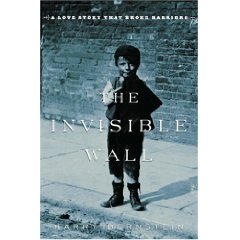 The Invisible Wall By Harry Berstein
 This fictional book has 292 pages. It is Lisa Genova’s first novel. Lisa also holds a Ph.D. in neuroscience from Harvard University. She is an online columnist for the National Alzheimer’s Association.
 Reflections