
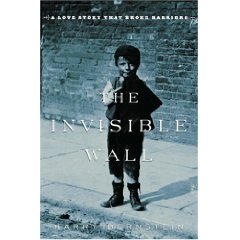
 The Invisible Wall By Harry Berstein
297 pages
Publisher: Ballantine Books
The is a true story about the life in the early 1900’s on a street in a small English mill town. On one side of the street lived the Christians and on the other side of the street lived the Jews. Even though the Christians and Jews live only a few feet apart from each other, there is an invisible wall that socially separates the street a very great distant. This wall at times seems insurmountable.
Harry’s father does not interact much with his family. He hardly provides enough for the family to live on. Harry’s mother is devoted to the family. She survives on the dreams she has for her children and hopes that one day the family will be able to go to America where everything will be better. Harry’s sister Lily does the unthinkable – she falls in love with Arthur. Arthur is the Christian boy that lives across the street.
During World War I, the invisible wall seemed to crumble. The families were friendly toward each other. During the war, a girl named Emily would bring the telegrams to announce to families who had died in the war. Whenever, Emily brought the bad news to a family it did not matter if the family were Christian or Jewish. Everyone, could feel the loss of the loved one and gave comfort to each other. However, once the war ended the wall was back in place.
This wall becomes most evident when Lily and Arthur get married and then tell their families. It is not acceptable for a Jew to marry a Christian. For the Jewish family, it becomes like the person has died. And that is exactly what Harry’s family did – conducted a funeral for Lily. This funeral offended the Christians on the street. On the Sabbath the Jewish families had Christians that would come over to light their cooking fires. Because of this funeral, the Christian who regularly attended the fire would not come. Arthur’s mom comes over to do it but it does not alter the wall. Personally, I was thought it was very neighborly for Arthur’s mom to do this. During the newlywed stage only Harry had contact with his sister. That is until the baby was born. The baby made it possible for the wall to come down a bit. The Christians and Jews celebrate the baby with a big party.
Another amazing thing about this book is the author – Harry Bernstein. He wrote this book when he was ninety-six years old – after the death of his wife Ruby. I found his memoirs to be most interesting and moving on what it must have been like to live the life of the working-class people in the 1900’s.
I liked this book very much. This may be because I am (as the book calls the Christian) a “goy” married to a Jew. Fortunately, for me a funeral was not conducted. However, I do believe that relations with family members were strained for many years on both sides of the family.

 Reflections